

Patton to Bastogne: The Southern Counteroffensive
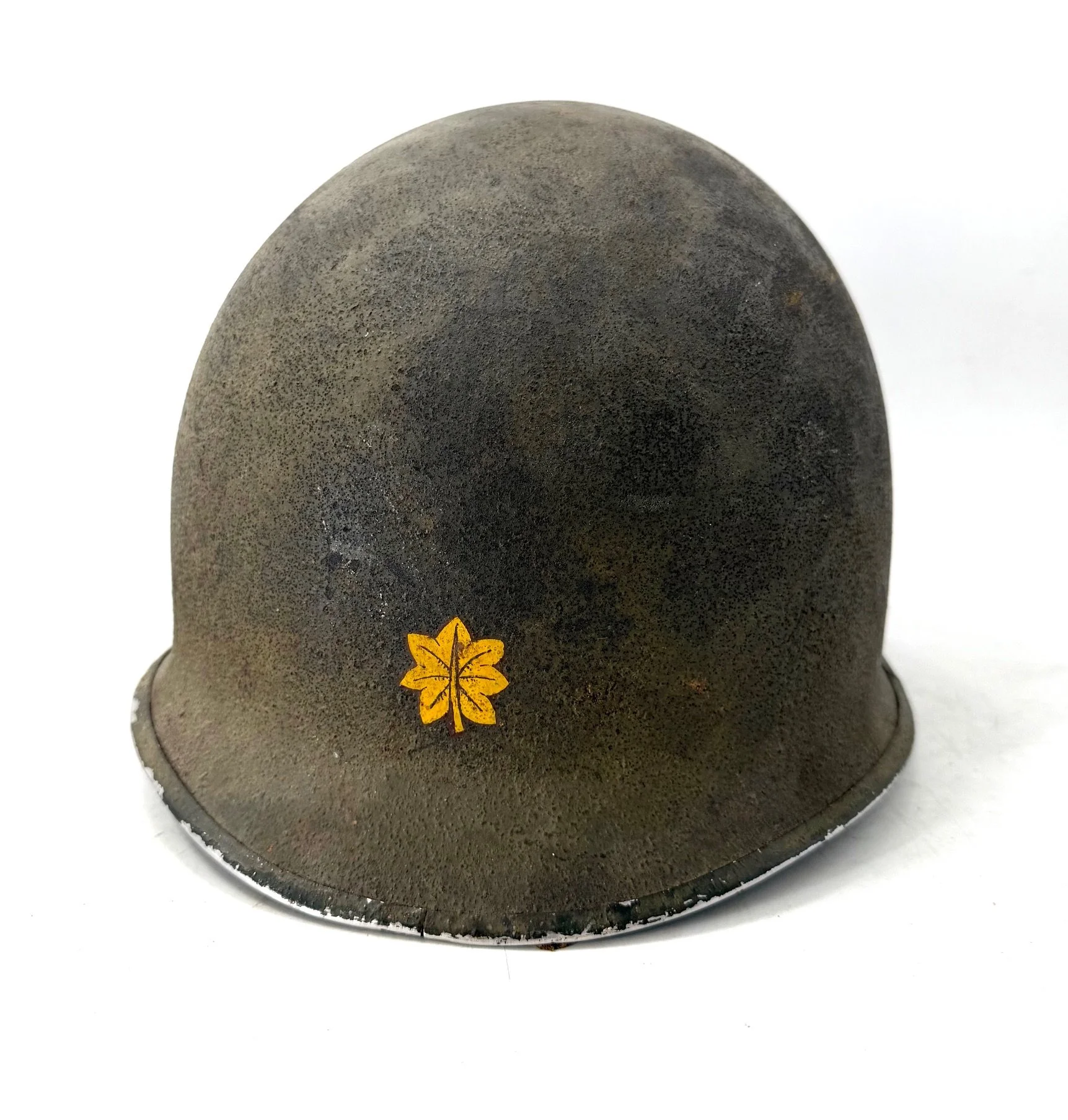
US WW2 Major M1 Helmet
The Battle of the Bulge, launched by German forces in December 1944, represented the last major offensive by Nazi Germany on the Western Front during the Second World War. While much attention has focused on the desperate defensive fighting in the Ardennes and the encirclement of Bastogne, the Allied response—particularly General George S. Patton’s counteroffensive on the southern flank—proved decisive in halting and ultimately reversing the German advance. Patton’s rapid maneuver of the U.S. Third Army demonstrated operational flexibility, logistical foresight, and aggressive leadership under extreme winter conditions.
On 16 December 1944, German forces launched a surprise attack through the densely forested Ardennes region, exploiting thinly held American lines. Adolf Hitler’s objective was ambitious: split the Allied armies, seize the port of Antwerp, and force a negotiated peace in the West. The sudden penetration of German armored units created a pronounced “bulge” in the Allied front lines, threatening to unhinge the Allied position in northwest Europe.
While the northern and central sectors bore the initial weight of the German assault, the southern flank—anchored by the U.S. Third Army—quickly assumed critical importance. If the German advance could be contained or countered from the south, the momentum of the offensive would be blunted and the encircled Allied forces, particularly at Bastogne, could be relieved.
General George S. Patton, commanding the U.S. Third Army, had anticipated the possibility of a German counteroffensive. His insistence on contingency planning enabled a rapid response once the scale of the attack became clear. During a high-level Allied conference on 19 December, Patton famously asserted that he could pivot his army ninety degrees and attack north within days—a claim that soon proved accurate.
Patton ordered elements of the Third Army to disengage from their ongoing offensive operations in Lorraine and redeploy toward the Ardennes. This maneuver, executed under severe winter weather conditions, required extraordinary coordination. Roads were icy, supply lines stretched, and visibility was limited, yet Third Army units moved with remarkable speed. By 22 December, Patton’s forces were already engaging German units on the southern flank of the bulge.
The most critical objective of Patton’s counteroffensive was the relief of Bastogne, a key road junction surrounded by German forces. The town’s defense by the U.S. 101st Airborne Division and other attached units delayed the German timetable but could not be sustained indefinitely without relief.
Patton assigned the mission to the III Corps, which attacked northward through heavy resistance. Despite snow, freezing temperatures, and stiff German defenses, Third Army units maintained pressure. On 26 December 1944, advance elements of the 4th Armored Division broke through to Bastogne, effectively ending the encirclement. This achievement marked a turning point in the battle, undermining German operational cohesion and morale.
Patton’s counteroffensive on the southern flank played a crucial role in the overall Allied victory at the Battle of the Bulge. By striking into the flank of the German advance, the Third Army forced German commanders to divert resources from their main thrust. The relief of Bastogne restored Allied freedom of movement and disrupted German supply lines at a moment when fuel and reinforcements were already scarce.
Moreover, the success of the southern counterattack exemplified Allied superiority in command flexibility and logistics. While German forces struggled to adapt once their initial momentum stalled, the Allies rapidly coordinated a multi-directional response that ultimately compressed and eliminated the bulge.